
GIP
An incretin pathway involved in insulin release and nutrient handling.
Retatrutide activates GIP, GLP-1 and glucagon receptors. Researchers study body-weight, glucose and liver-fat outcomes; community discussions focus on appetite control, gradual dose changes and the lowest amount that feels effective while allowing adequate eating.
Research focus: Body weight, appetite and metabolic outcomes.
Choose a compound to open its research, documentation and calculator.
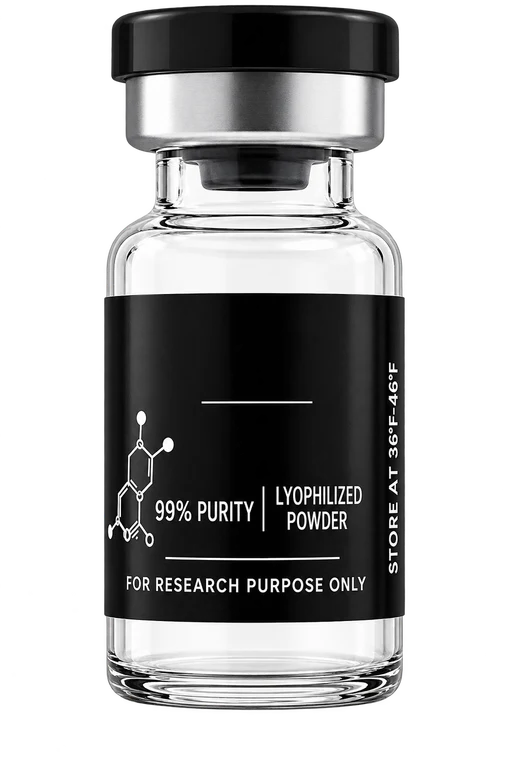
No FDA-approved drug product for this catalog material. Compounding eligibility and approval are separate questions.
Official source ↗Investigational study preparation; plasma decline is not the duration of every biological effect.
Half-life describes concentration falling by half. It does not set a dosing interval, a storage period or a drug-test detection window.
Kinetics source ↗PeptIQ lists bacteriostatic water for repeated-vial workflows. That preference is not a compatibility study for a particular formulation; the actual product or pharmacy instructions determine the liquid.
Bacteriostatic water contains a preservative; plain sterile water does not. Preservative presence does not by itself establish compatibility or a mixed medicine’s usable period.
Preparation source ↗Retatrutide remains investigational and is not FDA approved. Trial findings do not establish an approved prescribing schedule or verify a separately supplied vial.
Check that a source concerns the same molecule, formulation, route and population. A study of cells, animals or a different product cannot confirm the contents of a vial.
Published trials, sponsor results and separately attributed community accounts.
In plain English: retatrutide is designed to engage several of the body’s metabolic message systems with one molecule. An agonist is a substance that activates a receptor.
An incretin pathway involved in insulin release and nutrient handling.
A pathway involved in glucose-dependent insulin release and appetite regulation.
A metabolic pathway being investigated for its contribution to energy expenditure. Early supporting experiments included mice.
The discovery work measured activity at all three receptors. Animal mechanisms do not establish the size of each receptor’s contribution in humans. Read the original discovery paper ↗
Retatrutide’s activity differs across its three targets in laboratory assays. EC50 is the concentration producing half the maximum response in that assay; a lower value indicates greater potency, rather than a receptor that moves faster.
| Receptor | EC50 (nM) | Relative potency* |
|---|---|---|
| GIPR | 0.0643 | 8.9× native GIP |
| GLP-1R | 0.775 | 0.4× native GLP-1 |
| GCGR | 5.79 | 0.3× native glucagon |
*Compared with each receptor’s corresponding native peptide in the same study. These assay concentrations are different from an administered dose in mg.
Original receptor study ↗The linked discussions are self-reports, not verified independent-doctor research. A receptor assay can suggest a pharmacological hypothesis, but it does not measure receptor contributions at a particular human dose.
The lower glucagon-receptor potency in these assays helps explain the idea that a higher exposure could change the balance of effects. Some community commenters describe 4 mg as a milestone. The discovery study found activity at all three receptors; it did not identify a universal 4 mg “switch-on” point in people.
Read the community discussion ↗Other names you may encounter: LY3437943.
Learn to read a study →Each entry keeps one schedule’s amount, frequency and cycle together. Community references, individual reports, clinical trials and prescription products describe different kinds of use. A missing duration or break stays marked as not reported.
Amounts describe mass in mg or mcg. Syringe units describe volume and depend on concentration. A cycle break is different from days off within a week.
Choose an option to explore its amounts, timing and cycle.
| When | Amount & frequency |
|---|---|
| Weeks 1–4 | 2 mg once weekly |
| Weeks 5–8 | 4 mg once weekly; 4 mg arm stays here |
| Weeks 9–12 | 6 mg once weekly for higher-target arms |
| Weeks 13–16 | 9 mg once weekly; 9 mg arm stays here |
| Week 17 onward | 12 mg once weekly in the 12 mg arm |
An individual account with four weeks at each amount. It does not establish an automatic monthly increase for everyone.
Intermediate escalation amounts were not reported, so this entry does not supply a complete ramp.
| When | Amount & frequency |
|---|---|
| First 4 weeks | 2 mg once weekly |
| Next 4 weeks | 4 mg once weekly |
| Later stage | 6 mg once weekly |
Community identifies source origin. It does not certify independent funding, medical credentials or the strength of a claim. Source types distinguish published reports, professional explanations and public discussions.
Explore reports, explanations and discussions from medical practices, researchers, suppliers and community members. The badges identify the source’s origin and evidence type.
How to read these source labels →Not original clinical research or a representative survey. Its timing, preparation and switching suggestions are not validated by the cited trial.
Source relationship: Promotes its tracking app and includes telehealth referral disclosures.
The current article distinguishes trial schedules from community starting charts and explains concentration arithmetic. Individual forum schedules appear separately in our guide.
Commercial app explainer · trial and community context
A forum explainer is not a head-to-head trial or an independently measured UBT251 receptor-potency table. Cross-trial outcomes cannot prove superiority, and an unreported adverse-event signal is not evidence of absence.
Source relationship: The post recommends a named supplier and describes a product without an available lot-specific certificate at the time of writing. Any financial relationship is unverified. Inclusion is not a supplier or product endorsement.
The post compares triple-receptor targets, trial headlines and a proposed difference in glucagon weighting. Its receptor-balance and tolerability interpretations are discussed alongside primary sources in our UBT251 research article.
Community interpretation · includes supplier promotion · clinical credentials unverified
These are unverified personal accounts, not a clinician consensus or validated protocol. They do not establish that most users stay at 2–4 mg, or that hunger suppression alone determines effectiveness or safety.
Source relationship: Pseudonymous public discussion. Clinical credentials, product identity, funding and commercial relationships are not independently verified.
Some replies describe 1–2 mg starts, holding amounts for several weeks and seeking a lower effective amount. One reports four-week periods at 1, 2 and 3 mg; others report nausea at 1 mg, lower starts, or different schedules.
Self-reports · selected examples · no representative dose distribution
A peptide name and vial mass cannot determine a compatible diluent, powder displacement, storage temperature or discard date. Follow the exact product’s instructions and your pharmacist’s directions.
The injection guide concerns clinician-prescribed subcutaneous medicines; it does not establish that a research-labeled material can be injected.
Start with the formulation: dry powder, prepared solution, pen, tablet and topical product can have different instructions.
General health habits and consistent observations help you assess changes. They are not evidence that a peptide’s effects will be amplified.
Choose activity that fits your health and ability. Aerobic movement and muscle-strengthening work are part of general adult activity guidance.
CDC · adult activity ↗Use a regular sleep/wake schedule and note changes in sleep quality alongside symptoms or training.
CDC · sleep habits ↗What to record: Track food intake, appetite, activity and tolerability together. Appetite control should still leave room for adequate meals; review persistent eating difficulties with the treating clinician.
Check dates are editorial references, not a medical review certificate. Labels and evidence can change; consult the linked current document.
This timeline follows Lilly’s reported four-week escalation steps. Participants stopped escalating at their assigned target; the 4 mg group did not follow the entire 12 mg path. Other trials can investigate different schedules.
All amounts below were administered once weekly by subcutaneous injection. The full path to 12 mg included two 2 mg increases followed by two 3 mg increases.
The roughly 28% headline is a group average under a particular analysis, not a reason to pursue the highest amount. Compare the published result and analysis methods ↓
The phase 1b study reported a half-life of approximately six days. Half-life is the time for the drug concentration to fall by about half, rather than the time until it disappears. This supports the once-weekly interval studied in trials. Weekly exposures overlap, so levels build over several weeks. A simple half-life calculation suggests approaching steady state after roughly a month at an unchanged weekly amount; changing the amount starts a new adjustment period. The illustration below shows only the decline after one exposure.
Phase 1b paper ↗Illustrative exponential decline after a single exposure. Not an individual blood-level forecast; repeated doses overlap.
These are historical research arms, not an approved dosing plan. The 1 mg arm was not a universal first-month recommendation. Suitability, interactions, side effects and monitoring require clinical assessment.
All arms used once-weekly subcutaneous administration for 48 weeks.
| Trial arm | Starting amount | Escalation context |
|---|---|---|
| 1 mg | 1 mg | Fixed-dose arm |
| 4 mg | 2 or 4 mg | Separate starting-dose groups |
| 8 mg | 2 or 4 mg | Separate starting-dose groups |
| 12 mg | 2 mg | Escalation arm |
Escalation steps were separated by four weeks, for up to 12 weeks. Lower starts partly reduced gastrointestinal adverse events.
Original trial, protocol and safety results ↗These are selected public experiences, not a validated initiation plan or a representative survey. Clinical outcomes, interactions and monitoring matter alongside appetite and reported side effects. Trial schedules and self-directed schedules are different kinds of evidence.
In an August 2026 discussion, several people reported starting at 1–2 mg. One described spending four weeks at 1 mg, then four at 2 mg and four at 3 mg. Others used different intervals or reported nausea even at low amounts. These examples explain the community’s “low and slow” conversation; they do not establish a standard 1 mg increase every month.
“Lowest effective dose” describes a community preference for less hunger and food preoccupation while still being able to eat adequately, with few or no noticeable side effects. That is the balance PeptideLit’s founder also describes from community experience. The aim is manageable appetite, rather than making eating difficult. It is a preference, not a clinically validated dose-selection rule; appetite and tolerability alone do not measure all benefits or risks.
PeptIQ’s current guide discusses 0.25 mg community starting charts while distinguishing them from trial arms. The original forum accounts above provide individual weekly examples; they do not establish a safe switch from semaglutide or tirzepatide. Read the unofficial guide ↗
The TRIUMPH-1 schedule does not validate shortening the interval to four or five days. Giving the same amount more frequently changes exposure; a “microdose” label does not make those schedules equivalent.
Peptide Dosing Protocols describes introducing MOTS-c after four weeks of retatrutide alone, and explicitly notes that this sequence has not been tested in a trial. It is an online stacking proposal with supplier promotions, not evidence of added benefit or safety. Read the stacking proposal and its limitations ↗
Nausea, diarrhea and vomiting were among the common gastrointestinal events in the phase 2 trial; lower starting amounts partly reduced these effects. That does not establish that glucagon activity alone explains side effects or differences in community schedules. Trial safety findings ↗
Exposure depends on absorption, distribution and clearance, not just the size of the bloodstream. Retatrutide was engineered for albumin binding and prolonged exposure. The reviewed trial schedules used fixed amounts; they do not supply a body-weight-to-dose conversion.
Molecular design and early pharmacology ↗Selected studies and clinical reports, with the question, context and limitations close at hand.
Could retatrutide improve weight and obesity-related outcomes in a larger trial?
What happened in people with both obesity and type 2 diabetes?
Could a peptide acting on GIP, GLP-1, and glucagon receptors reduce body weight in adults with obesity?
Could triple-receptor activity improve glucose regulation as well as body weight?
Did liver fat change in participants with obesity and metabolic dysfunction-associated steatotic liver disease (MASLD)?
What did DXA scans show about the body composition behind the weight change?
Opening values and worked examples illustrate arithmetic; they are not preparation instructions or recommended amounts. Selecting a compound labels the calculation and does not supply a dose or powder-volume correction.
Enter the documented vial mass, preparation information and target amount to see how mass and volume connect.
20 mg in an assumed final 1 mL gives 20 mg/mL. An entered 1 mg corresponds to 0.05 mL, or 5 U-100 units, with 20 theoretical portions before losses.
Estimate · assumes 1 mL added = total volume
1,000 mcg
Theoretical · before losses
0.2 mL
After 5 full doses
Illustration only · calculated value, without rounding
Saved calculations stay on this device.
Concentration = mass ÷ final volume
5 mg ÷ 1 mL = 5 mg/mLVolume = target mass ÷ concentration
1 mg ÷ 5 mg/mL = 0.2 mLU-100 markings = volume × 100
0.2 mL × 100 = 20 unitsComplete portions = floor(vial mass ÷ amount per portion).
Displayed numbers are rounded for readability; the calculation uses unrounded values.
Already have the concentration? Find the matching mL and U-100 syringe reading.
Need the concentration first? Use the Reconstitution tab.
5units
0.05 mL · 0.25 mg
0.25 mg ÷ 5 mg/mL = 0.05 mLU-100 units = mL × 100Example inputs are editable. The reading is calculated without rounding to a physical graduation.
Convert mass or liquid volume. U-100 markings always refer to a 100-units-per-mL scale.
1,000mcg
For mass → syringe volume, switch to Dosage and enter a concentration.