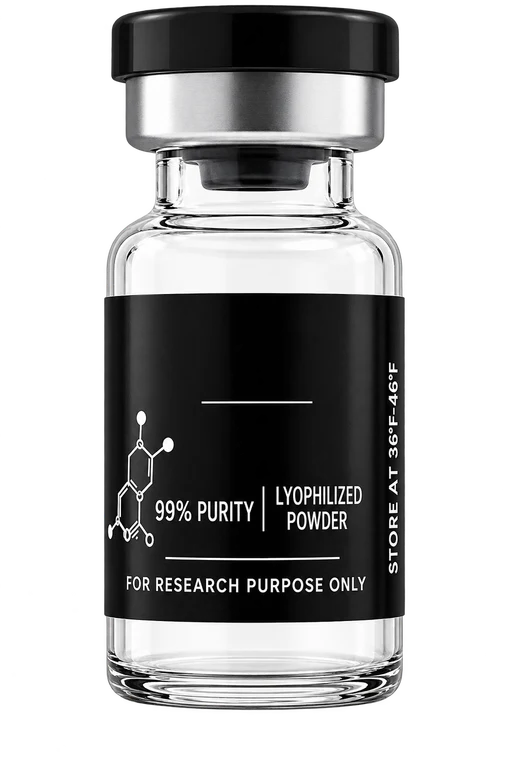
Tirzepatide activates GIP and GLP-1 receptors to help regulate blood glucose and food intake. Mounjaro and Zepbound have different treatment indications, while provider discussions often focus on finding a useful maintenance dose with manageable side effects.
Research focus: Appetite, body weight and blood-glucose control.
Randomized trials & product labelingSources checked October 12, 2026
Approved injections are supplied as solutions; do not add diluent. Tablets are not mixed. A separately supplied powder requires its own formulation documentation.
Bacteriostatic water contains a preservative; plain sterile water does not. Preservative presence does not by itself establish compatibility or a mixed medicine’s usable period.
The label instructions below apply to the named prescription products and their indications. A matching peptide name on another vial does not establish an equivalent formulation.
Check that a source concerns the same molecule, formulation, route and population. A study of cells, animals or a different product cannot confirm the contents of a vial.
Human clinical trials and US product labels, alongside labeled provider perspectives.
Each entry keeps one schedule’s amount, frequency and cycle together. Community references, individual reports, clinical trials and prescription products describe different kinds of use. A missing duration or break stays marked as not reported.
Amounts describe mass in mg or mcg. Syringe units describe volume and depend on concentration. A cycle break is different from days off within a week.
Choose an option to explore its amounts, timing and cycle.
Reported instructionsMonthly stages · reported provider planInjected; injection type not reported · Three-month plan; first eight injections completed at the time of reporting
Dose
2 → 4.5 → 7 mg per weekly injection
How often
Once weekly
Route
Injected; injection type not reported
Duration
Three-month plan; first eight injections completed at the time of reporting
Break after cycle
Not reported
Dose changes within this protocol
When
Amount & frequency
Month 1
2 mg once weekly
Month 2
4.5 mg once weekly
Month 3 · planned
7 mg once weekly
A reported plan with a future third stage, separate from the prescription-product schedules.
Individual community reportDivided weekly amount · reported useInjected; injection type not reported · Not reported
Dose
3.75 mg per administration
How often
Every 3.5 days
Route
Injected; injection type not reported
Duration
Not reported
Break after cycle
Not reported
7.5 mg total over seven days in this individual account.
Community identifies source origin. It does not certify independent funding, medical credentials or the strength of a claim. Source types distinguish published reports, professional explanations and public discussions.
Explore reports, explanations and discussions from medical practices, researchers, suppliers and community members. The badges identify the source’s origin and evidence type.
This explainer is not an original trial or a survey of community schedules.
Source relationship: Commercial telehealth and weight-management provider.
Ro Provider educational article
Ro discusses choosing maintenance according to response and tolerability, including continuing an effective treatment dose long term.
Provider perspective · commercial care service
FORMULATION FIRST
Reconstitution, storage and devices.
Product-specific handling
A peptide name and vial mass cannot determine a compatible diluent, powder displacement, storage temperature or discard date. Follow the exact product’s instructions and your pharmacist’s directions.
The injection guide concerns clinician-prescribed subcutaneous medicines; it does not establish that a research-labeled material can be injected.
Start with the formulation: dry powder, prepared solution, pen, tablet and topical product can have different instructions.
Storage: before and after opening.
US product label
Zepbound · single-dose pen or vial
Before opening
Refrigerate at 2–8°C (36–46°F), protected from light.
After mixing / first use
An unrefrigerated single-dose unit may be kept at ≤30°C (86°F) for a total of 21 days; discard after that limit or after use.
Handling & discard
Do not freeze. Multi-dose vials, KwikPens and Mounjaro presentations have their own in-use rules; identify the exact presentation.
Device and concentration come before syringe units.
Approved tirzepatide presentations include pens and vials. Single-dose presentations use 0.5 mL per dose; multi-dose vials and KwikPens use 0.6 mL per dose in the reviewed labels. Follow the instructions for the dispensed presentation.
A prescribed compounded vial has its own concentration and handling directions. Confirm the amount in mg, concentration in mg/mL and corresponding mL with the pharmacy. Branded ready-to-use products are not reconstitution recipes for research powder.
What to record: Track food intake, appetite, activity and tolerability together. Appetite control should still leave room for adequate meals; review persistent eating difficulties with the treating clinician.
GO TO THE ORIGINAL
Documentation behind Tirzepatide.
About source checks
Check dates are editorial references, not a medical review certificate. Labels and evidence can change; consult the linked current document.
The labels carry a thyroid C-cell tumor boxed warning, with unknown human risk. MTC history, MEN 2 and serious hypersensitivity are contraindications. Gastrointestinal effects, pancreatitis, dehydration and interactions with glucose-lowering medicines also need review.
Ro describes maintenance as a dose chosen with the prescriber according to response and tolerability. Some people continue an effective treatment amount long term; “maintenance” does not necessarily mean reducing it after reaching a weight goal.
That supports a practical conversation about benefits, side effects and adequate nutrition. It does not establish a universal four-week pause, automatic step-down or a schedule based only on appetite. Extending intervals to 8–10 days or using “microdoses” falls outside the labeled weekly plan.
Opening values and worked examples illustrate arithmetic; they are not preparation instructions or recommended amounts. Selecting a compound labels the calculation and does not supply a dose or powder-volume correction.
Enter the documented vial mass, preparation information and target amount to see how mass and volume connect.
An arithmetic example
20 mg in an assumed final 1 mL gives 20 mg/mL. An entered 1 mg corresponds to 0.05 mL, or 5 U-100 units, with 20 theoretical portions before losses.
Calculator inputsStarting numbers are worked examples, not recommended doses or preparation instructions. Dose-to-units and units-to-dose views describe the same quantities. The calculator defaults to 1 mL (100 U-100 units) of liquid added as an estimate of total solution volume.In plain EnglishChoose the amount on your vial label, the liquid you added, and the amount per dose you already want to calculate. Type an exact amount or use the slider; neither selects a dose for you.
CompoundSelect a name to organize your calculation. Names do not set the vial mass, target amount, or volume. NAD+ is a related compound, not a peptide. For blends, enter each component’s mass separately.In plain EnglishThis is the label on your calculation, like naming a folder. Choosing a name does not decide how much material or liquid to use.
Amount in the vialThe total mass of this compound in the vial, not its concentration. Use the mass stated in your source documentation. 1 mg = 1,000 mcg.In plain EnglishThink of mass as the amount of material you started with. Adding liquid spreads that material out; it does not create more of it. A vial marked 5 mg contains 5,000 mcg.
mg
Liquid added to the vialThe starting 1 mL (100 U-100 units) is an editable example. For a general estimate, we use the liquid added as the total solution volume; powder displacement is not included. If your preparation specifies a different final volume, enter it in Advanced. The calculator does not choose a diluent or mixing procedure.In plain English100 units on a U-100 syringe means 1 mL of liquid added; 200 units in total means 2 mL. The starting 1 mL (100 U-100 units) is an editable calculator example, not a mixing recommendation for every product. The simple calculation uses added liquid as an estimate of final volume. A correction needs data for the specific formulation, not just a peptide name. Enter a documented final volume in Advanced when available.
mL
Amount per doseType your exact amount, or adjust the 1–20 mg slider in whole-mg steps or click a labeled value. Type decimal amounts directly in the field. The slider range is a navigation shortcut, not a recommended dose range. Amounts below 1 mg or above 20 mg can be typed directly. Switching mg/mcg preserves the amount.In plain EnglishThe amount in the vial describes the whole batch. This input describes just one portion. For example, if a 5 mg vial makes 20 equal portions, each contains 0.25 mg (250 mcg). Enter the amount from your protocol and the calculator finds the liquid volume for it.
Slider range: 1 to 20 mg, in 1 mg steps. Click a labeled value to select it. Type exact decimal amounts in the field above.
Advanced Volume & syringe settings
Calculation basisA stated concentration is product-specific and refers to the selected blend component. It does not reveal a recoverable fill volume or establish the product’s allowed number of doses. Entering a different compound or blend component clears this concentration.In plain EnglishUse the mg/mL printed on your product label when you have it. Otherwise, you can use a documented final volume or keep the liquid-added estimate.
Syringe capacityOn a U-100 scale, 100 markings equal 1 mL. Capacity changes the displayed scale, not the concentration. These markings are not compound activity units (IU).In plain EnglishCapacity is how much liquid the syringe can hold when full. On a U-100 syringe, 10 units means 0.1 mL, and 100 units means 1 mL. A smaller syringe holds less, but each U-100 unit still means 0.01 mL.
Marked intervalRead the actual graduation spacing on your device. This setting flags values that fall between markings; it does not round the calculation or guarantee measurement accuracy.In plain EnglishThese are the steps between lines on your syringe. Like a ruler, a value can land between two lines. The calculator points that out instead of moving the answer to a nearby line.
02 / YOUR RESULTCalculated
Tirzepatide
Estimate · assumes 1 mL added = total volume
U-100 syringe1 mL capacity · 100 unitsSyringe capacityAll unit conversions here use a U-100 scale: 100 units = 1 mL. The selected capacity changes the maximum volume shown, not the concentration. These are volume scale units, not compound activity units (IU).In plain EnglishCapacity is how much liquid the syringe can hold when full. On a U-100 syringe, 10 units means 0.1 mL, and 100 units means 1 mL. A smaller syringe holds less, but each U-100 unit still means 0.01 mL.
Amount per dose
1 mg
1,000 mcg
Full doses per vial Doses per vialTotal vial mass divided by the entered dose amount, rounded down to complete doses. This is a theoretical count before handling losses. It may exceed the labeled usable doses because of overfill or discard instructions. A single-dose vial is not reusable just because arithmetic shows more portions.In plain EnglishAn aliquot is just a portion. This is how many full, equally sized portions the mixture could make in perfect conditions, like counting full glasses from a pitcher.
5
Theoretical · before losses
Syringe amount per dose Result displayBoth views describe the same calculated volume. U-100 scale units = volume in mL × 100. Changing the display does not change the concentration, target amount, or calculation. This conversion does not apply to other syringe scales or biological activity units (IU).In plain EnglishThe liquid amount stays the same when you switch views. It is like showing the same distance in centimeters or inches: only the number and label change. Here, 0.1 mL is 10 units on a U-100 syringe.
20units
0.2 mL
Amount remaining Amount remainingThe selected compound’s vial mass minus the mass in complete doses. This is a theoretical remainder, not a measured or recoverable amount; overfill, dead space, transfer losses and product discard rules are excluded.In plain EnglishAfter counting all the full doses, this is the amount left over on paper. A result of 0 mg means the amounts divide evenly; handling losses can still leave you with fewer usable doses.
0 mg
After 5 full doses
U-100 volume scaleVolume scaleThis illustration shows calculated volume against the selected capacity. It is not a physical measurement tool. The value is not rounded to the smallest marked interval.In plain EnglishThe picture helps you compare the answer with the syringe you selected. It is a drawing, so do not hold a real syringe up to your screen to measure liquid.
020406080100
Illustration only · calculated value, without rounding
Concentration & remaining liquid
Concentration ConcentrationMass divided by final solution volume. For a blend, this is the selected component’s concentration.In plain EnglishThink of juice concentrate: the same amount of concentrate in less water makes a stronger mixture. Here, mg/mL tells you how much material is in each 1 mL of liquid.
5 mg/mL
Per U-100 unit Amount per scale unitOne U-100 scale unit represents 0.01 mL. This is the mass of the selected compound in that volume.In plain EnglishEach U-100 unit is a tiny portion of liquid: one hundredth of a milliliter. This number tells you how much material is inside that tiny portion.
50 mcg
Full portions in vial Complete aliquotsTheoretical count of complete portions at the calculated volume. This excludes transfer loss, dead space, and any change in solution volume.In plain EnglishAn aliquot is just a portion. This is how many full, equally sized portions the mixture could make in perfect conditions, like counting full glasses from a pitcher.
5
Theoretical remainder Remaining volumeMass-equivalent liquid remaining after complete portions. This is not a measured fill or recoverable volume. Handling losses, overfill and product discard rules are not included.In plain EnglishThis is a paper-and-pencil remainder: leftover compound mass expressed as liquid. It does not measure what can be recovered from the vial. Losses and product discard instructions can make the usable amount smaller.
0 mL
Saved calculations stay on this device.
See the calculation
Concentration = mass ÷ final volume
5 mg ÷ 1 mL = 5 mg/mL
Volume = target mass ÷ concentration
1 mg ÷ 5 mg/mL = 0.2 mL
U-100 markings = volume × 100
0.2 mL × 100 = 20 units
Complete portions = floor(vial mass ÷ amount per portion).
Displayed numbers are rounded for readability; the calculation uses unrounded values.
CONCENTRATION → VOLUME
Convert a known dose.
Dosage calculatorUse the documented concentration and an amount you already want to calculate. U-100 units are volume markings, not biological activity units or IU.
Already have the concentration? Find the matching mL and U-100 syringe reading.
Need the concentration first? Use the Reconstitution tab.
YOUR CONVERSION
On a U-100 syringe
5units
0.05 mL · 0.25 mg
Volume = target amount ÷ concentration0.25 mg ÷ 5 mg/mL = 0.05 mLU-100 units = mL × 100
Example inputs are editable. The reading is calculated without rounding to a physical graduation.
ONE MEASUREMENT, ANOTHER UNIT
Keep the units clear.
Mass, volume and activity unitsMass and volume are separate dimensions. Converting between them requires a concentration. IU describes biological activity and has no universal conversion to mg or syringe units.
Convert mass or liquid volume. U-100 markings always refer to a 100-units-per-mL scale.
YOUR CONVERSION
1 mg equals
1,000mcg
1 g = 1,000 mg = 1,000,000 mcg
For mass → syringe volume, switch to Dosage and enter a concentration.