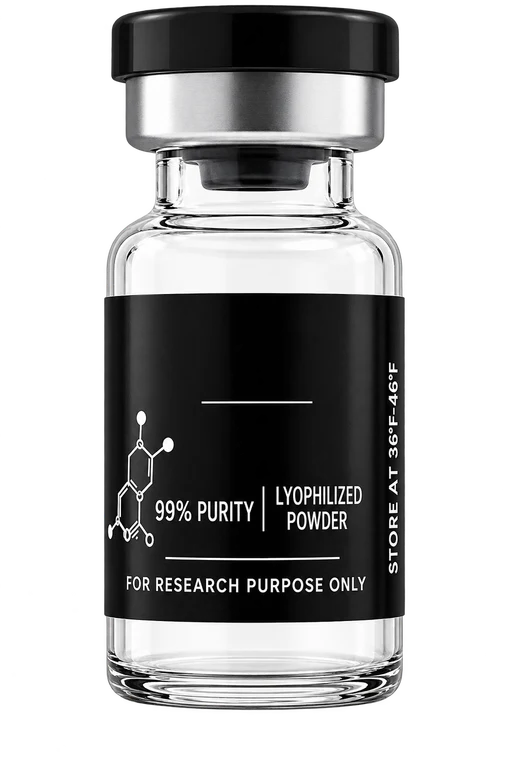
SS-31, or elamipretide, is researched for effects on mitochondrial function. The prescription product Forzinity received accelerated US approval to improve muscle strength in people with Barth syndrome weighing at least 30 kg.
Research focus: Mitochondrial function and Barth-syndrome muscle strength.
Narrow, product-specific approved indicationSources checked October 6, 2026
Community preparation guides describe BAC (bacteriostatic) water for lyophilized SS-31 research vials. This is separate from Forzinity, the approved elamipretide product supplied as a ready-made solution that is not reconstituted.
Bacteriostatic water contains a preservative; plain sterile water does not. Preservative presence does not by itself establish compatibility or a mixed medicine’s usable period.
BAC water · research vialsCommunity-reported · lyophilized powder
START WITH THE EVIDENCE
What the documentation tells us.
Evidence context
The label instructions below apply to the named prescription products and their indications. A matching peptide name on another vial does not establish an equivalent formulation.
Check that a source concerns the same molecule, formulation, route and population. A study of cells, animals or a different product cannot confirm the contents of a vial.
A narrow approved indication; broad healthy-aging uses are a different research question.
Each entry keeps one schedule’s amount, frequency and cycle together. Community references, individual reports, clinical trials and prescription products describe different kinds of use. A missing duration or break stays marked as not reported.
Amounts describe mass in mg or mcg. Syringe units describe volume and depend on concentration. A cycle break is different from days off within a week.
Choose an option to explore its amounts, timing and cycle.
Prescription productForzinity · Barth syndrome treatmentSubcutaneous · Ongoing prescribed treatment for the labeled indication
Dose
40 mg per injection; renal adjustment applies in adults
How often
Once daily, at the same time each day
Route
Subcutaneous
Duration
Ongoing prescribed treatment for the labeled indication
Break after cycle
No scheduled cycle break in the label
For adults with eGFR <30 mL/minute who are not on dialysis: the label specifies 20 mg daily. Dialysis instructions are not established. This is not a general healthy-aging regimen.
Individual community reportDaily use before MOTS-c · individual accountNot reported · 10–20 days
Dose
4 mg per day
How often
Daily
Route
Not reported
Duration
10–20 days
Break after cycle
Not reported
MOTS-c followed as a separate phase in this account.
A peptide name and vial mass cannot determine a compatible diluent, powder displacement, storage temperature or discard date. Follow the exact product’s instructions and your pharmacist’s directions.
The injection guide concerns clinician-prescribed subcutaneous medicines; it does not establish that a research-labeled material can be injected.
Start with the formulation: dry powder, prepared solution, pen, tablet and topical product can have different instructions.
Storage: before and after opening.
US product label
Forzinity · prescription elamipretide vial
Before opening
Refrigerate at 2–8°C (36–46°F). Do not freeze.
After mixing / first use
After first dose: refrigerate at 2–8°C or store at 20–25°C (68–77°F). Discard 8 days after first opening.
Handling & discard
Ready-to-use prescription solution. This eight-day rule does not establish storage for a separate SS-31 powder.
What to record: Choose measurable goals such as day-to-day function, exercise tolerance or symptoms. A cellular biomarker is different from a demonstrated improvement in health or lifespan.
GO TO THE ORIGINAL
Documentation behind SS-31.
About source checks
Check dates are editorial references, not a medical review certificate. Labels and evidence can change; consult the linked current document.
Opening values and worked examples illustrate arithmetic; they are not preparation instructions or recommended amounts. Selecting a compound labels the calculation and does not supply a dose or powder-volume correction.
Enter the documented vial mass, preparation information and target amount to see how mass and volume connect.
An arithmetic example
20 mg in an assumed final 1 mL gives 20 mg/mL. An entered 1 mg corresponds to 0.05 mL, or 5 U-100 units, with 20 theoretical portions before losses.
Calculator inputsStarting numbers are worked examples, not recommended doses or preparation instructions. Dose-to-units and units-to-dose views describe the same quantities. The calculator defaults to 1 mL (100 U-100 units) of liquid added as an estimate of total solution volume.In plain EnglishChoose the amount on your vial label, the liquid you added, and the amount per dose you already want to calculate. Type an exact amount or use the slider; neither selects a dose for you.
CompoundSelect a name to organize your calculation. Names do not set the vial mass, target amount, or volume. NAD+ is a related compound, not a peptide. For blends, enter each component’s mass separately.In plain EnglishThis is the label on your calculation, like naming a folder. Choosing a name does not decide how much material or liquid to use.
Amount in the vialThe total mass of this compound in the vial, not its concentration. Use the mass stated in your source documentation. 1 mg = 1,000 mcg.In plain EnglishThink of mass as the amount of material you started with. Adding liquid spreads that material out; it does not create more of it. A vial marked 5 mg contains 5,000 mcg.
mg
Liquid added to the vialThe starting 1 mL (100 U-100 units) is an editable example. For a general estimate, we use the liquid added as the total solution volume; powder displacement is not included. If your preparation specifies a different final volume, enter it in Advanced. The calculator does not choose a diluent or mixing procedure.In plain English100 units on a U-100 syringe means 1 mL of liquid added; 200 units in total means 2 mL. The starting 1 mL (100 U-100 units) is an editable calculator example, not a mixing recommendation for every product. The simple calculation uses added liquid as an estimate of final volume. A correction needs data for the specific formulation, not just a peptide name. Enter a documented final volume in Advanced when available.
mL
Amount per doseType your exact amount, or adjust the 1–20 mg slider in whole-mg steps or click a labeled value. Type decimal amounts directly in the field. The slider range is a navigation shortcut, not a recommended dose range. Amounts below 1 mg or above 20 mg can be typed directly. Switching mg/mcg preserves the amount.In plain EnglishThe amount in the vial describes the whole batch. This input describes just one portion. For example, if a 5 mg vial makes 20 equal portions, each contains 0.25 mg (250 mcg). Enter the amount from your protocol and the calculator finds the liquid volume for it.
Slider range: 1 to 20 mg, in 1 mg steps. Click a labeled value to select it. Type exact decimal amounts in the field above.
Advanced Volume & syringe settings
Calculation basisA stated concentration is product-specific and refers to the selected blend component. It does not reveal a recoverable fill volume or establish the product’s allowed number of doses. Entering a different compound or blend component clears this concentration.In plain EnglishUse the mg/mL printed on your product label when you have it. Otherwise, you can use a documented final volume or keep the liquid-added estimate.
Syringe capacityOn a U-100 scale, 100 markings equal 1 mL. Capacity changes the displayed scale, not the concentration. These markings are not compound activity units (IU).In plain EnglishCapacity is how much liquid the syringe can hold when full. On a U-100 syringe, 10 units means 0.1 mL, and 100 units means 1 mL. A smaller syringe holds less, but each U-100 unit still means 0.01 mL.
Marked intervalRead the actual graduation spacing on your device. This setting flags values that fall between markings; it does not round the calculation or guarantee measurement accuracy.In plain EnglishThese are the steps between lines on your syringe. Like a ruler, a value can land between two lines. The calculator points that out instead of moving the answer to a nearby line.
02 / YOUR RESULTCalculated
SS-31
Estimate · assumes 1 mL added = total volume
U-100 syringe1 mL capacity · 100 unitsSyringe capacityAll unit conversions here use a U-100 scale: 100 units = 1 mL. The selected capacity changes the maximum volume shown, not the concentration. These are volume scale units, not compound activity units (IU).In plain EnglishCapacity is how much liquid the syringe can hold when full. On a U-100 syringe, 10 units means 0.1 mL, and 100 units means 1 mL. A smaller syringe holds less, but each U-100 unit still means 0.01 mL.
Amount per dose
1 mg
1,000 mcg
Full doses per vial Doses per vialTotal vial mass divided by the entered dose amount, rounded down to complete doses. This is a theoretical count before handling losses. It may exceed the labeled usable doses because of overfill or discard instructions. A single-dose vial is not reusable just because arithmetic shows more portions.In plain EnglishAn aliquot is just a portion. This is how many full, equally sized portions the mixture could make in perfect conditions, like counting full glasses from a pitcher.
5
Theoretical · before losses
Syringe amount per dose Result displayBoth views describe the same calculated volume. U-100 scale units = volume in mL × 100. Changing the display does not change the concentration, target amount, or calculation. This conversion does not apply to other syringe scales or biological activity units (IU).In plain EnglishThe liquid amount stays the same when you switch views. It is like showing the same distance in centimeters or inches: only the number and label change. Here, 0.1 mL is 10 units on a U-100 syringe.
20units
0.2 mL
Amount remaining Amount remainingThe selected compound’s vial mass minus the mass in complete doses. This is a theoretical remainder, not a measured or recoverable amount; overfill, dead space, transfer losses and product discard rules are excluded.In plain EnglishAfter counting all the full doses, this is the amount left over on paper. A result of 0 mg means the amounts divide evenly; handling losses can still leave you with fewer usable doses.
0 mg
After 5 full doses
U-100 volume scaleVolume scaleThis illustration shows calculated volume against the selected capacity. It is not a physical measurement tool. The value is not rounded to the smallest marked interval.In plain EnglishThe picture helps you compare the answer with the syringe you selected. It is a drawing, so do not hold a real syringe up to your screen to measure liquid.
020406080100
Illustration only · calculated value, without rounding
Concentration & remaining liquid
Concentration ConcentrationMass divided by final solution volume. For a blend, this is the selected component’s concentration.In plain EnglishThink of juice concentrate: the same amount of concentrate in less water makes a stronger mixture. Here, mg/mL tells you how much material is in each 1 mL of liquid.
5 mg/mL
Per U-100 unit Amount per scale unitOne U-100 scale unit represents 0.01 mL. This is the mass of the selected compound in that volume.In plain EnglishEach U-100 unit is a tiny portion of liquid: one hundredth of a milliliter. This number tells you how much material is inside that tiny portion.
50 mcg
Full portions in vial Complete aliquotsTheoretical count of complete portions at the calculated volume. This excludes transfer loss, dead space, and any change in solution volume.In plain EnglishAn aliquot is just a portion. This is how many full, equally sized portions the mixture could make in perfect conditions, like counting full glasses from a pitcher.
5
Theoretical remainder Remaining volumeMass-equivalent liquid remaining after complete portions. This is not a measured fill or recoverable volume. Handling losses, overfill and product discard rules are not included.In plain EnglishThis is a paper-and-pencil remainder: leftover compound mass expressed as liquid. It does not measure what can be recovered from the vial. Losses and product discard instructions can make the usable amount smaller.
0 mL
Saved calculations stay on this device.
See the calculation
Concentration = mass ÷ final volume
5 mg ÷ 1 mL = 5 mg/mL
Volume = target mass ÷ concentration
1 mg ÷ 5 mg/mL = 0.2 mL
U-100 markings = volume × 100
0.2 mL × 100 = 20 units
Complete portions = floor(vial mass ÷ amount per portion).
Displayed numbers are rounded for readability; the calculation uses unrounded values.
CONCENTRATION → VOLUME
Convert a known dose.
Dosage calculatorUse the documented concentration and an amount you already want to calculate. U-100 units are volume markings, not biological activity units or IU.
Already have the concentration? Find the matching mL and U-100 syringe reading.
Need the concentration first? Use the Reconstitution tab.
YOUR CONVERSION
On a U-100 syringe
5units
0.05 mL · 0.25 mg
Volume = target amount ÷ concentration0.25 mg ÷ 5 mg/mL = 0.05 mLU-100 units = mL × 100
Example inputs are editable. The reading is calculated without rounding to a physical graduation.
ONE MEASUREMENT, ANOTHER UNIT
Keep the units clear.
Mass, volume and activity unitsMass and volume are separate dimensions. Converting between them requires a concentration. IU describes biological activity and has no universal conversion to mg or syringe units.
Convert mass or liquid volume. U-100 markings always refer to a 100-units-per-mL scale.
YOUR CONVERSION
1 mg equals
1,000mcg
1 g = 1,000 mg = 1,000,000 mcg
For mass → syringe volume, switch to Dosage and enter a concentration.