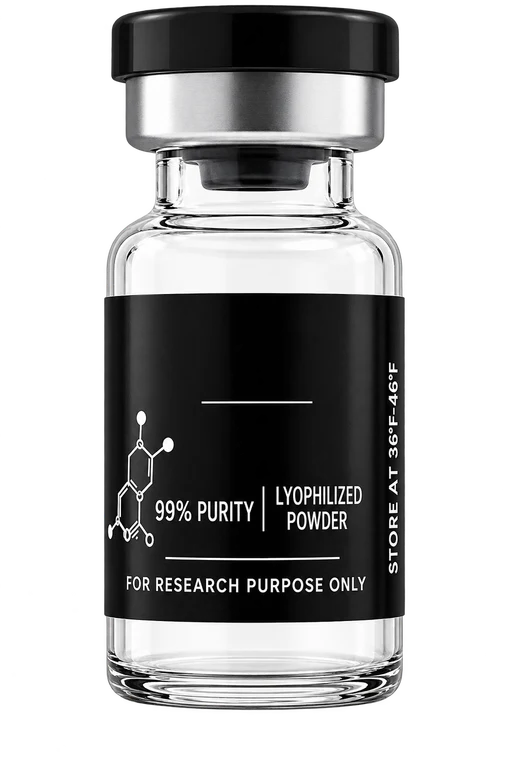
MOTS-c is a short mitochondria-derived signal studied in cellular energy regulation and metabolic adaptation. Clinic and community discussions connect it with exercise and body-composition goals; the original experiments here measured effects in cells and mice.
Research focus: Metabolic signaling and exercise-related interest.
Preclinical metabolic research · community and clinic descriptionsSources checked October 12, 2026
PeptIQ’s reported value has not been matched here to a primary human PK study for the exact molecule and route. Treat it as a reference estimate, not an established dosing interval.
Half-life describes concentration falling by half. It does not set a dosing interval, a storage period or a drug-test detection window.
PeptIQ lists bacteriostatic water for repeated-vial workflows. That preference is not a compatibility study for a particular formulation; the actual product or pharmacy instructions determine the liquid.
Bacteriostatic water contains a preservative; plain sterile water does not. Preservative presence does not by itself establish compatibility or a mixed medicine’s usable period.
The animal and cell findings do not establish a human weight-loss dose or injection schedule.
Check that a source concerns the same molecule, formulation, route and population. A study of cells, animals or a different product cannot confirm the contents of a vial.
Preclinical metabolic findings, with clinic and online protocols labeled separately.
Each entry keeps one schedule’s amount, frequency and cycle together. Community references, individual reports, clinical trials and prescription products describe different kinds of use. A missing duration or break stays marked as not reported.
Amounts describe mass in mg or mcg. Syringe units describe volume and depend on concentration. A cycle break is different from days off within a week.
Choose an option to explore its amounts, timing and cycle.
Reported protocolFour injections · periodic blockSubcutaneous · 4 injections in a 20-day window (20 mg total)
Dose
5 mg per injection
How often
Every 5 days: days 1, 6, 11 and 16
Route
Subcutaneous
Duration
4 injections in a 20-day window (20 mg total)
Break after cycle
4 months after the block
Time of day
Morning before food
Four 5 mg administrations total 20 mg within the 20-day block.
Community guideOnce-weekly optionSubcutaneous · Not reported
Dose
5 mg per injection
How often
Once weekly (5 mg/week)
Route
Subcutaneous
Duration
Not reported
Break after cycle
Not reported
Community guideTwice-weekly optionSubcutaneous · Not reported
Dose
2.5 mg per injection
How often
Twice weekly (5 mg/week)
Route
Subcutaneous
Duration
Not reported
Break after cycle
Not reported
Community guideThree-times-weekly optionSubcutaneous · Not reported
Dose
3.3 mg per injection
How often
Three times weekly (9.9 mg/week)
Route
Subcutaneous
Duration
Not reported
Break after cycle
Not reported
Community guideSmaller daily amountsSubcutaneous · Not reported
Dose
0.5–1 mg per day (500–1,000 mcg)
How often
Daily (3.5–7 mg over 7 days)
Route
Subcutaneous
Duration
Not reported
Break after cycle
Not reported
This option totals 3.5–7 mg over a seven-day week.
Community guideLarger intermittent amountsSubcutaneous · Not reported
Community identifies source origin. It does not certify independent funding, medical credentials or the strength of a claim. Source types distinguish published reports, professional explanations and public discussions.
Explore reports, explanations and discussions from medical practices, researchers, suppliers and community members. The badges identify the source’s origin and evidence type.
The clinic describes four administrations followed by a longer break.
Clinic description · not a controlled trial
CommunityVendor explainer
Daily versus weekly proposals
PeptIQ: evidence & source context
No direct human comparison establishes a preferred schedule.
Source relationship: Promotes a peptide-tracking app.
PeptIQ Commercial app publisher
The article compares smaller daily amounts with larger intermittent amounts. Our guide separates the weekly arithmetic from the proposed AMPK rationale.
Online explanation · commercial app
FORMULATION FIRST
Reconstitution, storage and devices.
Product-specific handling
A peptide name and vial mass cannot determine a compatible diluent, powder displacement, storage temperature or discard date. Follow the exact product’s instructions and your pharmacist’s directions.
The injection guide concerns clinician-prescribed subcutaneous medicines; it does not establish that a research-labeled material can be injected.
Start with the formulation: dry powder, prepared solution, pen, tablet and topical product can have different instructions.
Storage: before and after opening.
Research-vial reference
Community-reported ranges
Dry powder · reported shelf life
18–24 months
After mixing · reported window
21–30 days
Refrigeration · reported range
2–8°C · 36–46°F
Freezer
Dry powder only in the reference
Room temperature · reported limit
Under 12 hours
Handling note
Keep the lot label, mixing date and documented discard date together.
5 mg is not a fixed number of syringe units.
On a U-100 syringe, 25 units = 0.25 mL. That volume contains 5 mg only at 20 mg/mL. At 10 mg/mL, the same 25 units contains 2.5 mg. These are concentration examples, not mixing instructions.
Storage claims conflict. MOTSc.com says seven days after mixing, while Path To Peptides says 30 days. A website’s generic number does not establish stability or sterility for another formulation. Use documented formulation-specific handling and discard information; refrigeration alone cannot verify a usable period. Seven-day claim ↗ · 30-day claim ↗
What to record: Track food intake, appetite, activity and tolerability together. Appetite control should still leave room for adequate meals; review persistent eating difficulties with the treating clinician.
GO TO THE ORIGINAL
Documentation behind MOTS-c.
About source checks
Check dates are editorial references, not a medical review certificate. Labels and evidence can change; consult the linked current document.
The clinic’s example places 5 mg administrations on days 1, 6, 11 and 16: 20 mg across the block. The final administration is on day 16 of the described 20-day window, not day 20.
These comparisons show arithmetic, not bioequivalence. There is no established conversion from a weekly total to an equally safe or effective daily schedule. Clinic explainers and commercial online guides are not head-to-head clinical trials.
Path To Peptides gives these three examples. Its 3.3 mg entry totals 9.9 mg, rounded to about 10 mg weekly.
Cycle length belongs to its source. Lamkin’s 8–12-week example accompanies 5 mg per injection three to five times weekly—15–25 mg weekly. Its longer cycle cannot simply be attached to the lower weekly amounts above. Check the clinic’s full schedule ↗
Daily “microdosing” and AMPK
PeptIQ argues for more consistent AMPK signaling with smaller daily amounts. That is a proposed rationale; the article does not provide a human comparison proving steady signaling, better outcomes or lower risk. Read the publisher’s rationale ↗
Morning, fasted or before exercise?
Lamkin favors mornings or 30–60 minutes before exercise. Perfect B’s detailed instructions say morning before food, but its opening summary says bedtime. These descriptions do not establish a best time or a requirement to fast. Lamkin’s timing description ↗ · Perfect B’s differing wording ↗
What the safety evidence can tell us.
About reported risks and precautions
Clinic pages discuss injection-site reactions and possible glucose-lowering effects, especially alongside metabolic medicines. They also advise caution around pregnancy, breastfeeding and active cancer. These are practitioner precautions, not a complete, regulator-approved contraindication or interaction list. Reliable human adverse-event rates are not established by the linked explainers.
FDA identifies limited human exposure information and concerns about immunogenicity, peptide impurities and product characterization. The schedules above do not resolve those gaps; neither “research use only” nor a clinic’s description constitutes drug approval. Read FDA’s MOTs-C entry ↗
THE MATH, EXPLAINED
MOTS-c calculator.
About calculator examples
Opening values and worked examples illustrate arithmetic; they are not preparation instructions or recommended amounts. Selecting a compound labels the calculation and does not supply a dose or powder-volume correction.
Enter the documented vial mass, preparation information and target amount to see how mass and volume connect.
An arithmetic example
20 mg in an assumed final 1 mL gives 20 mg/mL. An entered 1 mg corresponds to 0.05 mL, or 5 U-100 units, with 20 theoretical portions before losses.
Calculator inputsStarting numbers are worked examples, not recommended doses or preparation instructions. Dose-to-units and units-to-dose views describe the same quantities. The calculator defaults to 1 mL (100 U-100 units) of liquid added as an estimate of total solution volume.In plain EnglishChoose the amount on your vial label, the liquid you added, and the amount per dose you already want to calculate. Type an exact amount or use the slider; neither selects a dose for you.
CompoundSelect a name to organize your calculation. Names do not set the vial mass, target amount, or volume. NAD+ is a related compound, not a peptide. For blends, enter each component’s mass separately.In plain EnglishThis is the label on your calculation, like naming a folder. Choosing a name does not decide how much material or liquid to use.
Amount in the vialThe total mass of this compound in the vial, not its concentration. Use the mass stated in your source documentation. 1 mg = 1,000 mcg.In plain EnglishThink of mass as the amount of material you started with. Adding liquid spreads that material out; it does not create more of it. A vial marked 5 mg contains 5,000 mcg.
mg
Liquid added to the vialThe starting 1 mL (100 U-100 units) is an editable example. For a general estimate, we use the liquid added as the total solution volume; powder displacement is not included. If your preparation specifies a different final volume, enter it in Advanced. The calculator does not choose a diluent or mixing procedure.In plain English100 units on a U-100 syringe means 1 mL of liquid added; 200 units in total means 2 mL. The starting 1 mL (100 U-100 units) is an editable calculator example, not a mixing recommendation for every product. The simple calculation uses added liquid as an estimate of final volume. A correction needs data for the specific formulation, not just a peptide name. Enter a documented final volume in Advanced when available.
mL
Amount per doseType your exact amount, or adjust the 1–20 mg slider in whole-mg steps or click a labeled value. Type decimal amounts directly in the field. The slider range is a navigation shortcut, not a recommended dose range. Amounts below 1 mg or above 20 mg can be typed directly. Switching mg/mcg preserves the amount.In plain EnglishThe amount in the vial describes the whole batch. This input describes just one portion. For example, if a 5 mg vial makes 20 equal portions, each contains 0.25 mg (250 mcg). Enter the amount from your protocol and the calculator finds the liquid volume for it.
Slider range: 1 to 20 mg, in 1 mg steps. Click a labeled value to select it. Type exact decimal amounts in the field above.
Advanced Volume & syringe settings
Calculation basisA stated concentration is product-specific and refers to the selected blend component. It does not reveal a recoverable fill volume or establish the product’s allowed number of doses. Entering a different compound or blend component clears this concentration.In plain EnglishUse the mg/mL printed on your product label when you have it. Otherwise, you can use a documented final volume or keep the liquid-added estimate.
Syringe capacityOn a U-100 scale, 100 markings equal 1 mL. Capacity changes the displayed scale, not the concentration. These markings are not compound activity units (IU).In plain EnglishCapacity is how much liquid the syringe can hold when full. On a U-100 syringe, 10 units means 0.1 mL, and 100 units means 1 mL. A smaller syringe holds less, but each U-100 unit still means 0.01 mL.
Marked intervalRead the actual graduation spacing on your device. This setting flags values that fall between markings; it does not round the calculation or guarantee measurement accuracy.In plain EnglishThese are the steps between lines on your syringe. Like a ruler, a value can land between two lines. The calculator points that out instead of moving the answer to a nearby line.
02 / YOUR RESULTCalculated
MOTS-c
Estimate · assumes 1 mL added = total volume
U-100 syringe1 mL capacity · 100 unitsSyringe capacityAll unit conversions here use a U-100 scale: 100 units = 1 mL. The selected capacity changes the maximum volume shown, not the concentration. These are volume scale units, not compound activity units (IU).In plain EnglishCapacity is how much liquid the syringe can hold when full. On a U-100 syringe, 10 units means 0.1 mL, and 100 units means 1 mL. A smaller syringe holds less, but each U-100 unit still means 0.01 mL.
Amount per dose
1 mg
1,000 mcg
Full doses per vial Doses per vialTotal vial mass divided by the entered dose amount, rounded down to complete doses. This is a theoretical count before handling losses. It may exceed the labeled usable doses because of overfill or discard instructions. A single-dose vial is not reusable just because arithmetic shows more portions.In plain EnglishAn aliquot is just a portion. This is how many full, equally sized portions the mixture could make in perfect conditions, like counting full glasses from a pitcher.
5
Theoretical · before losses
Syringe amount per dose Result displayBoth views describe the same calculated volume. U-100 scale units = volume in mL × 100. Changing the display does not change the concentration, target amount, or calculation. This conversion does not apply to other syringe scales or biological activity units (IU).In plain EnglishThe liquid amount stays the same when you switch views. It is like showing the same distance in centimeters or inches: only the number and label change. Here, 0.1 mL is 10 units on a U-100 syringe.
20units
0.2 mL
Amount remaining Amount remainingThe selected compound’s vial mass minus the mass in complete doses. This is a theoretical remainder, not a measured or recoverable amount; overfill, dead space, transfer losses and product discard rules are excluded.In plain EnglishAfter counting all the full doses, this is the amount left over on paper. A result of 0 mg means the amounts divide evenly; handling losses can still leave you with fewer usable doses.
0 mg
After 5 full doses
U-100 volume scaleVolume scaleThis illustration shows calculated volume against the selected capacity. It is not a physical measurement tool. The value is not rounded to the smallest marked interval.In plain EnglishThe picture helps you compare the answer with the syringe you selected. It is a drawing, so do not hold a real syringe up to your screen to measure liquid.
020406080100
Illustration only · calculated value, without rounding
Concentration & remaining liquid
Concentration ConcentrationMass divided by final solution volume. For a blend, this is the selected component’s concentration.In plain EnglishThink of juice concentrate: the same amount of concentrate in less water makes a stronger mixture. Here, mg/mL tells you how much material is in each 1 mL of liquid.
5 mg/mL
Per U-100 unit Amount per scale unitOne U-100 scale unit represents 0.01 mL. This is the mass of the selected compound in that volume.In plain EnglishEach U-100 unit is a tiny portion of liquid: one hundredth of a milliliter. This number tells you how much material is inside that tiny portion.
50 mcg
Full portions in vial Complete aliquotsTheoretical count of complete portions at the calculated volume. This excludes transfer loss, dead space, and any change in solution volume.In plain EnglishAn aliquot is just a portion. This is how many full, equally sized portions the mixture could make in perfect conditions, like counting full glasses from a pitcher.
5
Theoretical remainder Remaining volumeMass-equivalent liquid remaining after complete portions. This is not a measured fill or recoverable volume. Handling losses, overfill and product discard rules are not included.In plain EnglishThis is a paper-and-pencil remainder: leftover compound mass expressed as liquid. It does not measure what can be recovered from the vial. Losses and product discard instructions can make the usable amount smaller.
0 mL
Saved calculations stay on this device.
See the calculation
Concentration = mass ÷ final volume
5 mg ÷ 1 mL = 5 mg/mL
Volume = target mass ÷ concentration
1 mg ÷ 5 mg/mL = 0.2 mL
U-100 markings = volume × 100
0.2 mL × 100 = 20 units
Complete portions = floor(vial mass ÷ amount per portion).
Displayed numbers are rounded for readability; the calculation uses unrounded values.
CONCENTRATION → VOLUME
Convert a known dose.
Dosage calculatorUse the documented concentration and an amount you already want to calculate. U-100 units are volume markings, not biological activity units or IU.
Already have the concentration? Find the matching mL and U-100 syringe reading.
Need the concentration first? Use the Reconstitution tab.
YOUR CONVERSION
On a U-100 syringe
5units
0.05 mL · 0.25 mg
Volume = target amount ÷ concentration0.25 mg ÷ 5 mg/mL = 0.05 mLU-100 units = mL × 100
Example inputs are editable. The reading is calculated without rounding to a physical graduation.
ONE MEASUREMENT, ANOTHER UNIT
Keep the units clear.
Mass, volume and activity unitsMass and volume are separate dimensions. Converting between them requires a concentration. IU describes biological activity and has no universal conversion to mg or syringe units.
Convert mass or liquid volume. U-100 markings always refer to a 100-units-per-mL scale.
YOUR CONVERSION
1 mg equals
1,000mcg
1 g = 1,000 mg = 1,000,000 mcg
For mass → syringe volume, switch to Dosage and enter a concentration.